
By Ferdi Appelgryn | Coach, C Beyond Health
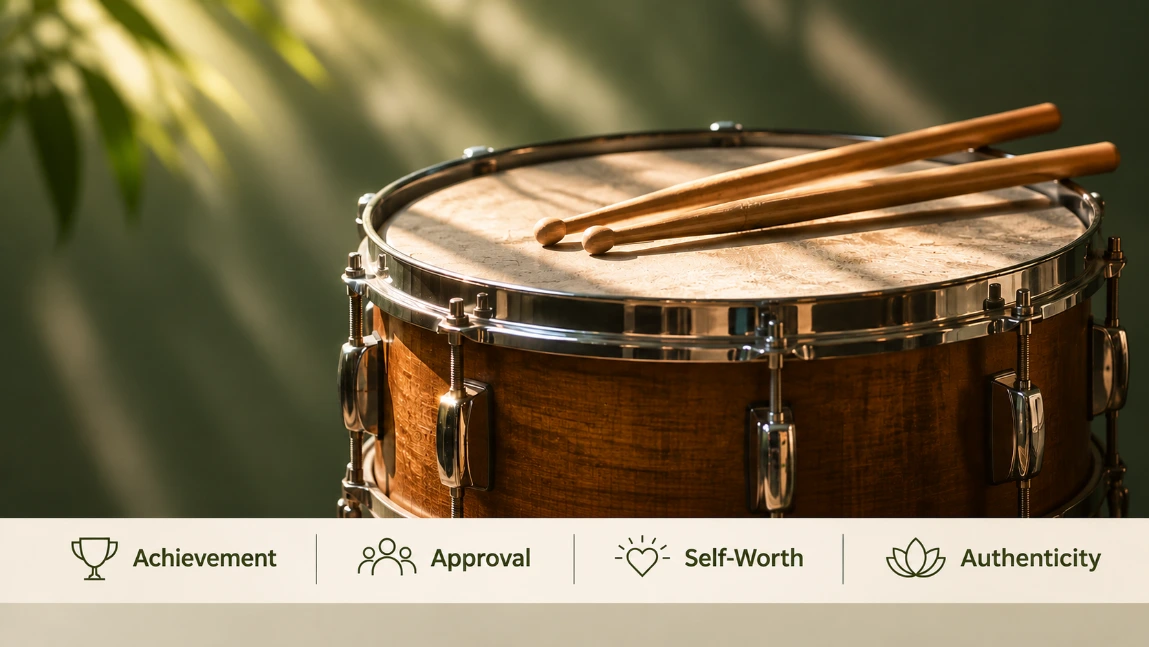
Imagine someone who knows exactly what life is about. They wake up every morning with a drum, and they know, with absolute clarity, that the purpose of life is to beat that drum. Loudly. So that people notice.
They beat it at work. They beat it at home. They beat it on social media, at the braai, in the way they dress, the car they drive and how busy they tell everyone they are. And people do notice. That's the strange part. People notice the noise.
But the more people notice, the more self-conscious our drummer becomes. Are they looking because it's good? Or because it's not good enough? Did they notice that missed beat? Are they expecting something even better next time? Eventually, our drummer comes to a perfectly logical conclusion. If I beat my drum louder, surely it'll get better.
Right?
Why achievement never seems to be enough
I see versions of this drum in almost every person who comes into my coaching practice. It doesn't always look the same. For some, it's achievement. For others, it's being the person who holds everything together. Sometimes it's being liked, being right, being needed or being the one who never lets anybody down.
Underneath these different behaviours, there's often a similar belief: in order for me to be okay, I need to do something, achieve something or perform in a particular way. And here's what makes that belief so convincing. It doesn't feel like a belief. It feels like the truth. It feels like clarity about how the world works.
Now, there's absolutely nothing wrong with doing cool stuff. Build the business. Run the race. Write the book. If you're doing something because you genuinely enjoy doing it, that's wonderful. The difficulty starts when your sense of worth becomes dependent on the outcome. When achievement is no longer something you enjoy, but something you need in order to feel good enough.
Think about the last time you achieved something important. Did you really enjoy it, or did you mostly feel relieved that you hadn't failed? It's worth considering, because the same achievement can feel very different depending on what you believe it says about you.
What happens when you keep trying to prove yourself?
There's a pattern I see quite often in people who have spent years achieving, performing and meeting expectations.
At first, you know what you know. Life makes sense. You understand what's expected of you, you've worked out how to get results, and the drum is working, more or less. Then, at some point, something changes. You get the title, the house, the relationship or the recognition you've been working towards, but the satisfaction you expected doesn't quite arrive. Or it arrives and disappears much more quickly than you imagined.
You've done what you thought you needed to do. So why doesn't it feel like enough?
Most of us respond in a remarkably predictable way. When something isn't working, we do more of it. We work harder, become more accommodating, take on more responsibility or set ourselves an even bigger goal. We beat the drum louder, hoping that this time the result will finally deliver what we've been looking for.
For some people, the tension eventually becomes impossible to ignore. Burnout, a relationship breakdown or another significant life event forces them to reconsider how they've been living. In the addiction world, there's a term for this kind of turning point: rock bottom.
But many people never reach that point. They remain perfectly functional. Functional workaholics. Functional people-pleasers. Functionally exhausted. They keep performing, keep achieving and keep appearing to manage everything. From the outside, life may look remarkably successful. Inside, maintaining it all requires more and more effort.
And so they keep beating the drum.
When your self-worth depends on performance
One of the difficulties with tying your self-worth to achievement is that the goalposts keep moving. If being successful is what makes you feel acceptable, yesterday's success doesn't necessarily help you today. You have to demonstrate it again. The promotion you worked so hard for becomes the new starting point. The business you built now has to keep growing. The people you've spent years trying to please still need to be pleased tomorrow.
Eventually, it can become difficult to distinguish between the things you genuinely want and the things you believe you must do to maintain your sense of being okay.
This can happen to people who are very capable, very accomplished and highly regarded by others. In fact, the ability to perform under pressure can make the pattern harder to recognise. It may be one of the reasons you've been so successful.
But being good at something doesn't necessarily mean that the reason you're doing it is good for you.
The shift: you don't need a better drum
When people begin questioning this pattern, the temptation is often to find a better way to perform. A new productivity system, a more disciplined routine, another qualification or a different goal. But what if the problem isn't the drum? What if it's the belief that you need to keep beating it in order to be okay?
Here's where I'd like to offer you something different. In my experience, meaningful transformation often begins when people become curious about the difference between their outer world and their inner experience.
The outer world is where we achieve, perform, build relationships and receive recognition. Those things matter, and they can bring enormous enjoyment and satisfaction. But they cannot, on their own, settle every question we have about ourselves. When we continually look outside ourselves for reassurance about our worth, we can spend an extraordinary amount of energy managing how we appear to other people.
People often think transformation means becoming somebody different. A new, improved version. But in my experience, transformation isn't necessarily something you add. It's something you reveal.
For you to transform, you must become you.
And perhaps that's why so many people feel exhausted, even when they're doing things they once enjoyed. Sometimes the tiredness comes from the work itself. But sometimes it comes from the extraordinary effort of trying to be the person you believe you're supposed to be.
What changes when you stop chasing approval?
When you begin to recognise this pattern, you don't necessarily have to change everything about your life. You may still want to build the business, run the race or achieve something extraordinary. There's no reason to stop pursuing the things that genuinely matter to you.
But your relationship with those things can change. You can pursue a goal without making your entire sense of worth dependent on reaching it. You can disagree with someone without having to prove that you're right. You can help somebody without needing to become indispensable, and you can succeed without immediately wondering what you'll have to achieve next.
There's a freedom in being able to enjoy what you do without asking every achievement to prove something about who you are.
When the drum no longer has to prove something, you can still play it. You might even play it better. But now it's music.
A small practice for the week
I'd like to suggest something simple. This week, notice your own drum. There's no need to fix it or judge yourself for having one. The exercise is simply to become more aware of when it's playing.
First, catch the beat. When you notice yourself working particularly hard to be seen, liked, impressive or in control, pause for a moment and acknowledge what's happening. You might simply say to yourself, "There's the drum."
Then, become curious about your motivation. Ask yourself whether you're doing this because you genuinely want to, or because you believe you have to. Are you enjoying the experience, or trying to avoid the discomfort of not measuring up? There's no wrong answer. Just notice what comes up.
Finally, put the sticks down for a little while. Once this week, do something purely because you enjoy it. No audience, no outcome to measure and no photograph to share. Just something that gives you pleasure in the doing. Notice how you feel while you're doing it.
At the end of the week, write down one thing you noticed. It doesn't have to be a profound insight. One honest observation is enough. You may discover that some of the things you've been working so hard to achieve are still important to you, while others start to look a little different.
And perhaps you'll begin to notice that the quiet you've been looking for was there all along, somewhere between the beats.
About Ferdi Appelgryn
Ferdi Appelgryn is a coach at C Beyond Health in Hermanus, working with individuals, professionals and leadership teams to explore the patterns and beliefs that influence how they live, work and perform.
If this article has made you curious about your own patterns, you're welcome to book a free 20-minute coaching conversation, in person or online.
See Your Health Differently.